
Palm Bay, FL · 321-804-8235
AC Leak Repair in Palm Bay, FL
There are two completely different AC leaks. Water leaks come from condensate drainage problems and threaten your home's finishes. Refrigerant leaks come from the sealed cooling circuit and reduce cooling capacity.
What this service covers
Water on the floor near an air handler and a system that has slowly lost cooling are both called "AC leaks," but they involve different components, different risks, and different repairs. Sorting out which one you have is the first step.
In humid Palm Bay, a working air conditioner removes a substantial amount of moisture from indoor air every day. That water has to leave the building through a drain system. When it does not, it finds drywall, insulation, and ceilings instead.
Symptoms
Signs you need this repair
- Water pooling around the base of an indoor unit or in the closet
- A brown stain or soft spot on a ceiling below an attic air handler
- Water dripping from a secondary drain line outside a wall
- The system shuts off by itself and restarts later (float switch cycling)
- Gradual loss of cooling over weeks or months with no other symptom
- Ice on refrigerant lines or hissing near the indoor coil
- Musty odor near the air handler or in supply air
Causes
What usually causes the problem
Clogged condensate drain line
Biological growth and dust form a plug in the drain, so the pan fills and overflows or the safety switch stops the system.
Rusted or cracked drain pan
Older air handlers can develop pan failures that let water bypass the drain entirely.
Disconnected or improperly sloped drain
A drain that lost its pitch, or a fitting that separated, drains into the cabinet or ceiling instead of outside.
Frozen evaporator coil melting
Ice that forms during operation overwhelms the pan when it melts, producing sudden large volumes of water.
Refrigerant leak at the coil
Corrosion pinholes in evaporator coils are a common refrigerant leak source, especially in coastal air.
Leaking fittings or line set
Service valves, flare and braze joints, and line sets damaged by vibration or physical impact lose refrigerant slowly.
Diagnosis
How the problem is diagnosed
Measurement comes before parts. These are the checks that separate one cause from another.
- Drain pan, primary drain, and secondary drain condition
- Float switch function and wiring
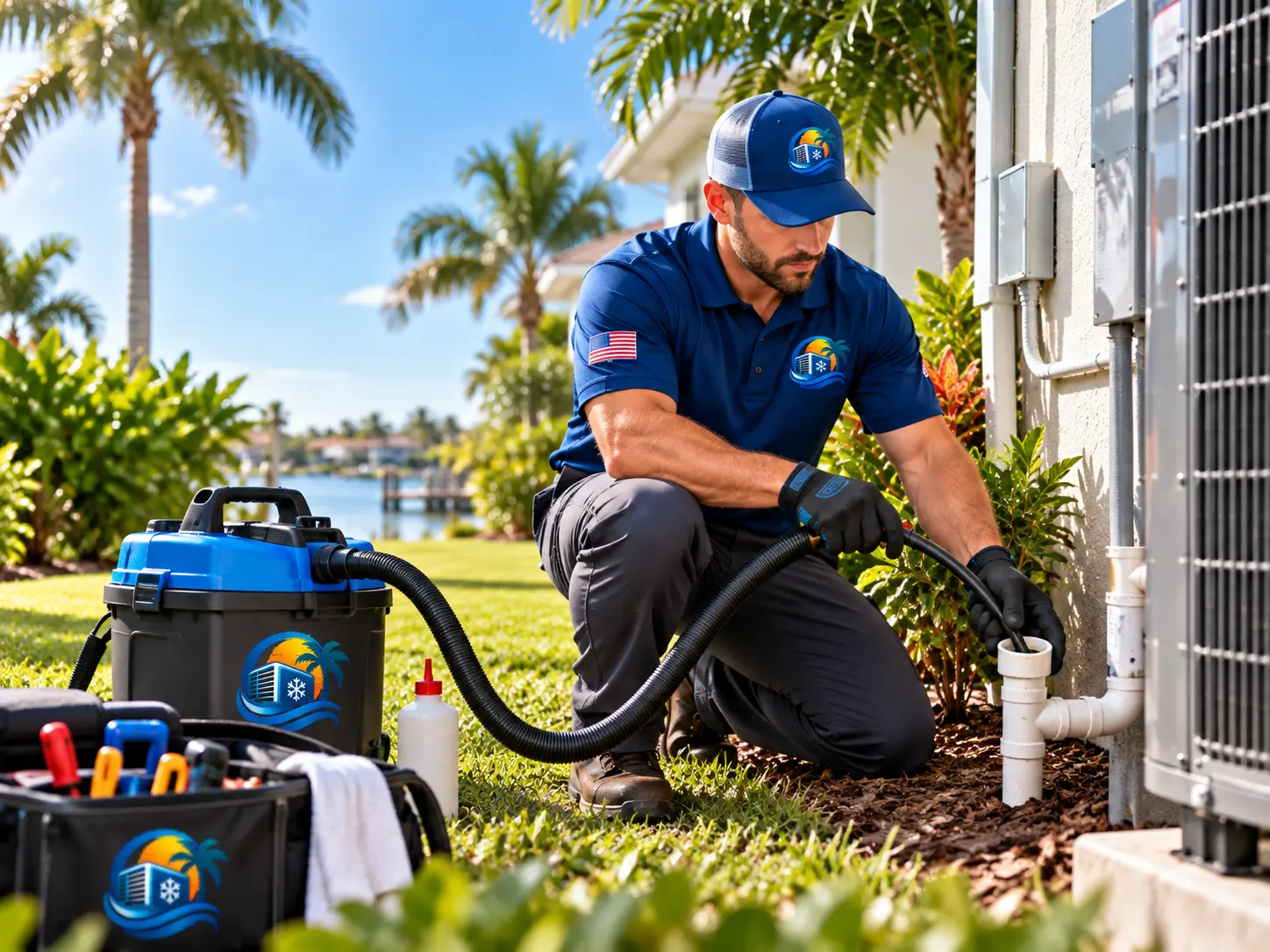
- Drain line clearing with vacuum or nitrogen, then flow verification
- Coil condition, including corrosion and evidence of oil residue
- Electronic leak detection and bubble testing at accessible joints
- Refrigerant pressures, superheat, and subcooling to confirm undercharge
- Insulation and surrounding materials for moisture damage
Repair options
What the repair involves
Drain clearing and treatment
Clearing the blockage, verifying flow, and correcting slope or fittings stops water leaks in most cases.
Pan and switch replacement
Where the pan is compromised or the float switch has failed, replacing them protects the home from a repeat event.
Refrigerant leak repair
Accessible joint leaks can often be repaired, followed by evacuation and a weighed charge.
Coil replacement
Coils with multiple corrosion leaks are replaced rather than patched, since repeated repairs rarely hold.
Urgency
How quickly this should be handled
Active water near ceilings, walls, flooring, or electrical equipment
A float switch that keeps shutting the system down
Visible mold growth or strong musty odor near the air handler
Rapid refrigerant loss with ice forming on the lines
Palm Bay conditions
Why this happens here
Palm Bay's humidity means condensate volume is high for much of the year, so a partially blocked drain becomes a full failure quickly. Attic air handlers make the consequences worse because water travels through insulation and ceiling drywall before anyone notices.
Proximity to the Indian River Lagoon adds a corrosion factor for coils and cabinets in some neighborhoods. Salt-laden humid air accelerates pitting on aluminum and copper components, which is one reason coil-related refrigerant leaks appear on systems that are otherwise in decent shape.
Cost
What affects the price of this repair
No two systems are identical. These factors move the number up or down, and each is explained before work begins.
Water versus refrigerant
Drain clearing is one of the least expensive AC repairs. Refrigerant leak work involves diagnosis, repair, evacuation, and charge.
Component involved
A fitting repair is modest; an evaporator coil replacement is a major repair with significant labor.
Secondary damage
Water that reached drywall, insulation, or flooring adds restoration cost beyond the HVAC repair itself.
Refrigerant type and volume
R-22 systems make recharging expensive enough to change the repair-versus-replace calculation.
Frequently asked questions
- Is water leaking from my AC dangerous?
- It is rarely a safety hazard in the electrical sense, but it is one of the more expensive AC problems if ignored, because the damage happens to your home rather than your equipment. Condensate water reaching drywall, ceiling joists, insulation, or flooring creates conditions for mold growth and structural damage, and remediation frequently costs more than the original drain repair would have. Water near electrical components in the air handler is also a genuine concern. The practical response is to shut the system off at the thermostat, contain the water, and get the drain diagnosed rather than emptying a bucket for weeks.
- How do I know whether I have a refrigerant leak?
- Refrigerant leaks usually show as a gradual decline in cooling over weeks or months rather than a sudden failure. Other signs include ice forming on the copper lines or indoor coil, an oily residue near coil bends or fittings, a hissing or bubbling sound near the indoor unit, and longer and longer run times to reach the same temperature. There is no reliable homeowner test, since a sealed system's charge is verified by pressure, superheat, and subcooling measurements. What matters is understanding that refrigerant is not consumed like fuel — if it is low, there is a leak, and finding it is part of the repair.
- Can I clear a clogged AC drain line myself?
- Sometimes, at least partially. Many Florida systems have an accessible cleanout tee near the air handler and a visible drain termination outside. Applying a wet/dry vacuum at the outside termination for a couple of minutes can pull out a soft blockage, and that is a reasonable homeowner attempt. What homeowners should avoid is forcing pressurized air or water through a line, which can separate joints inside a wall or push water into the cabinet. If the clog returns quickly, if the drain has lost its slope, or if the float switch keeps tripping, the drain assembly itself needs attention rather than repeated clearing.
- Why does my AC leak water only sometimes?
- Intermittent leaks usually mean a partial blockage or a pan that only overflows under peak conditions. On the hottest, most humid days the system produces the most condensate, so a drain that handles moderate flow finally backs up. Another common pattern is a coil that freezes lightly during operation: while ice is present, water is trapped, and once the system cycles off, the melt overwhelms the pan at once. A third possibility is a drain that has lost pitch and only backs up when volume is high. All three are best diagnosed by inspecting the pan, drain path, and coil condition together.
Related AC services
Areas we serve in Palm Bay
Talk through your AC problem now
Describe what your system is doing — not cooling, leaking, freezing, short cycling, or completely off — and get straightforward next steps.
Air Conditioner Repair Palm Bay FL1501 Robert J Conlan Blvd NE, Suite #459
Palm Bay, FL 32905