
Palm Bay, FL · 321-804-8235
Thermostat Repair in Palm Bay, FL
A thermostat is a switch and a sensor. When it fails, or when the low-voltage wiring feeding it fails, the air conditioner behaves exactly as though the equipment itself is broken — which is why controls get checked before parts get replaced.
What this service covers
Every cooling call starts at the thermostat. If it is not sending a signal, or if it is reading temperature incorrectly, a perfectly healthy system will sit idle, run at the wrong times, or cycle in ways that look like a mechanical fault.
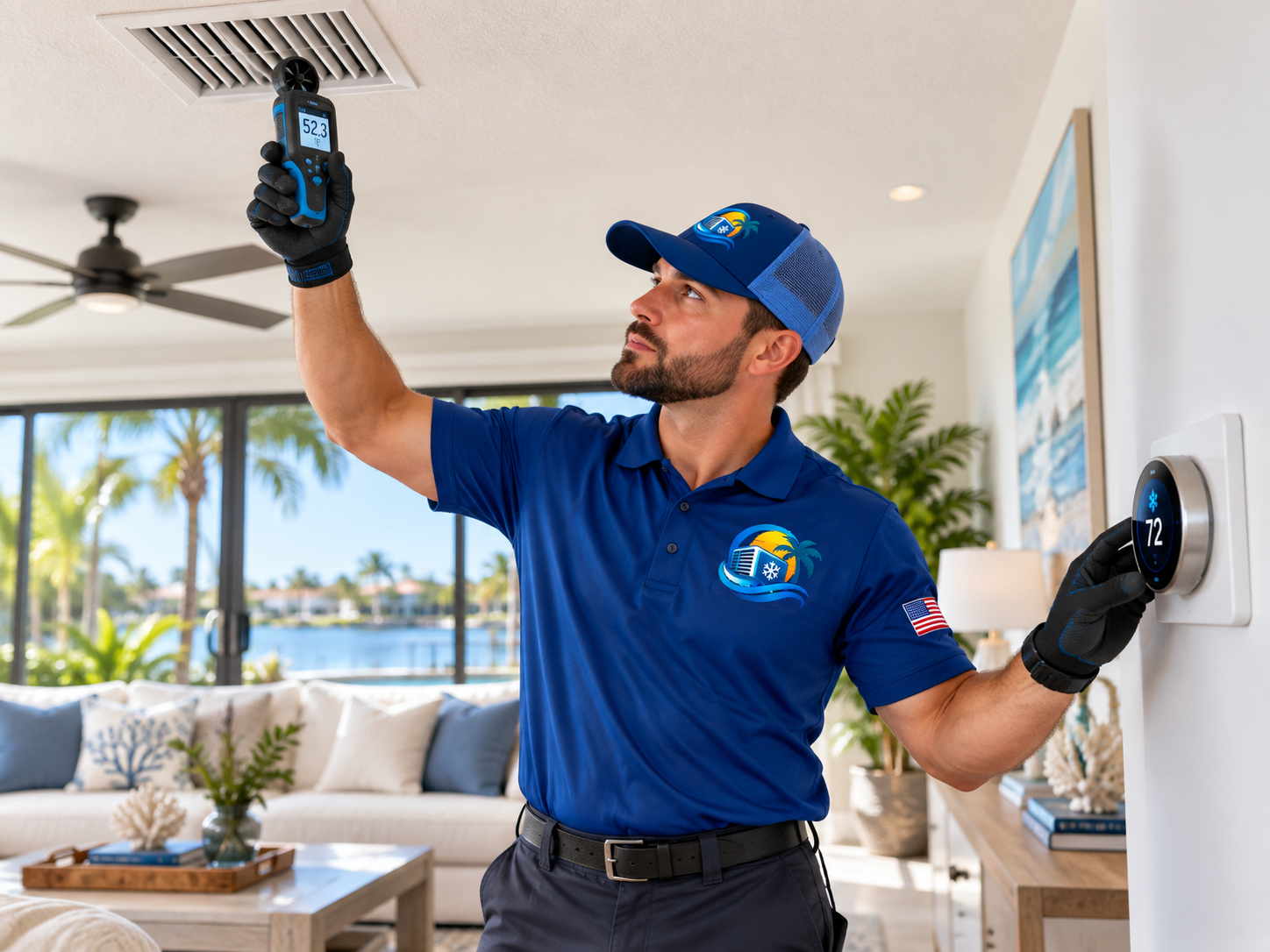
Thermostat issues have become more common with smart thermostats. Many require a common wire for continuous power, and installations that rely on power stealing can behave erratically, especially on older air handlers or systems with certain control boards.
Symptoms
Signs you need this repair
- A blank or unresponsive thermostat display
- The system will not turn on despite a cooling call
- Cooling runs constantly and never shuts off
- Short cycling — on and off every few minutes
- Room temperature clearly differs from the displayed reading
- A smart thermostat that keeps rebooting or losing connection
- The fan runs but the compressor never starts
Causes
What usually causes the problem
Dead batteries or power loss
The simplest and most common cause. Battery-powered thermostats fail gradually and can behave strangely before going dark.
Blown low-voltage fuse
A short in thermostat wiring often blows the 3- or 5-amp fuse on the air handler board, silencing the whole system.
Failed transformer
No 24-volt control power means no cooling call regardless of thermostat condition.
Wiring faults
Loose terminals, corroded connections, or wire damage from renovation work interrupt the signal intermittently.
Missing common wire
Smart thermostats without a C-wire may power-steal, causing reboots, false calls, or short cycling.
Sensor drift or bad placement
A thermostat in direct sun, near a supply register, or on an exterior wall reads the wrong temperature and controls the house poorly.
Configuration errors
Incorrect equipment type settings — especially heat pump versus conventional — cause backwards or absent operation.
Diagnosis
How the problem is diagnosed
Measurement comes before parts. These are the checks that separate one cause from another.
- Display, battery, and power source verification
- 24-volt control power at the thermostat and at the air handler
- Low-voltage fuse condition on the control board
- Terminal-by-terminal wiring check, including the common wire
- Jumper test to confirm equipment responds to a direct call
- Thermostat calibration against a measured room temperature
- Location assessment for sun, drafts, or register influence
- Equipment configuration settings, including heat pump options
Repair options
What the repair involves
Battery and fuse replacement
Often the entire repair, though a blown fuse always prompts a search for the short that caused it.
Wiring repair
Repairing damaged low-voltage wire, tightening terminations, and correcting miswired terminals restores reliable operation.
C-wire solution
Adding a common wire or an appropriate adapter resolves smart thermostat power problems permanently.
Thermostat replacement and setup
When the thermostat has failed or drifted, replacement includes correct equipment configuration and verification of every mode.
Urgency
How quickly this should be handled
The system is completely off during dangerous heat
Cooling runs continuously and cannot be shut off from the thermostat
Repeated blown fuses, which indicate an active short
Any burning smell at the air handler control board
Palm Bay conditions
Why this happens here
Palm Bay's lightning activity is a real factor for controls. Nearby strikes and utility surges damage thermostats and control boards more often than most homeowners expect, and the symptom is usually a system that worked earlier the same day.
Thermostat placement also matters more in Florida homes with large windows and sliding glass doors. A thermostat catching afternoon sun on a west wall will satisfy early and leave the rest of the house warm, which gets misread as an equipment capacity problem.
Cost
What affects the price of this repair
No two systems are identical. These factors move the number up or down, and each is explained before work begins.
Nature of the fault
Batteries and fuses are minimal. Wiring repair depends on access and length. Thermostat replacement depends on the model chosen.
C-wire installation
Running a new conductor or installing an adapter adds labor, especially where wall access is limited.
Board or transformer replacement
Control board failures are a larger part cost than thermostat components themselves.
System type
Heat pumps and zoned systems involve more control wiring and configuration than single-stage cooling-only setups.
Frequently asked questions
- How do I know if the problem is my thermostat or my AC?
- A few checks narrow it quickly. If the display is blank, start with batteries or control power. If the display works, set the system to cool and lower the setpoint several degrees; you should hear a click and the indoor blower should start within a moment, with the outdoor unit following. If nothing happens anywhere, the likely area is control power, wiring, or the thermostat. If the indoor blower runs but the outdoor unit never starts, the thermostat is probably sending its signal and the issue lies in the outdoor electrical components. A technician can confirm by jumpering terminals at the air handler, which either proves the equipment responds or points back to controls.
- Can a bad thermostat make the AC run constantly?
- Yes. A thermostat with a failed sensor, a stuck relay, or a shorted wire can hold the cooling call on continuously, and the system will run until you cut power at the breaker. A thermostat placed where it reads warmer than the room — direct sun, above a lamp, on an exterior wall, or near a heat-producing appliance — will also keep calling for cooling that the rest of the house does not need. Before assuming the equipment is undersized or low on refrigerant, it is worth verifying that the thermostat reads accurately and that the cooling call actually stops when the setpoint is reached.
- Do smart thermostats cause problems with older AC systems?
- They can, and the usual culprit is power rather than compatibility in the broad sense. Many smart thermostats need continuous 24-volt power through a common wire. Where no C-wire exists, some units power-steal through the cooling circuit, which can cause reboots, phantom cooling calls, short cycling, or a chattering relay on older control boards. Heat pump systems add another layer, because incorrect configuration of the reversing valve setting produces heating when cooling is expected. A smart thermostat works well on most systems when it has proper power and is configured for the actual equipment type — both of which are verifiable at installation.
- Why does my thermostat show the right temperature but the house feels warm?
- Two common explanations. First, the thermostat measures air at one point on one wall, and a home with duct losses, uneven airflow, or high solar gain can have several degrees of variation from room to room. Second, comfort in Florida depends heavily on humidity. A house at 75 degrees and 62 percent relative humidity feels noticeably worse than the same temperature at 50 percent. If the thermostat reading is accurate but the home feels warm or clammy, the productive investigation is airflow, duct condition, and whether the system is running long enough to dehumidify — not thermostat accuracy.
Related AC services
Areas we serve in Palm Bay
Talk through your AC problem now
Describe what your system is doing — not cooling, leaking, freezing, short cycling, or completely off — and get straightforward next steps.
Air Conditioner Repair Palm Bay FL1501 Robert J Conlan Blvd NE, Suite #459
Palm Bay, FL 32905