
How it works
The AC Repair Process
From the first phone call to the final measurement, here is how a repair visit typically works and what to expect at each step.
Why the process is worth describing
Most frustration with air conditioning repair comes from opacity: a technician disappears into the attic, returns with a number, and the homeowner has no way to evaluate it. Describing the process in advance changes that. You know what is being measured, why it matters, and how a conclusion was reached.
It also protects you from a common and expensive pattern — parts replaced in sequence until the symptom changes. Every step below exists to identify the actual fault before anything is purchased, because paying for accurate diagnosis is almost always cheaper than paying for the wrong part.
Step by step
The five stages of a repair visit
1. Symptom intake
On the phone or through the form, the details captured are what the system is actually doing: blower running or not, outdoor unit running or not, air cool or not, any ice, water, or tripped breaker, and how long it has been happening. That narrows the likely cause before a visit and determines urgency.
2. Measured diagnosis
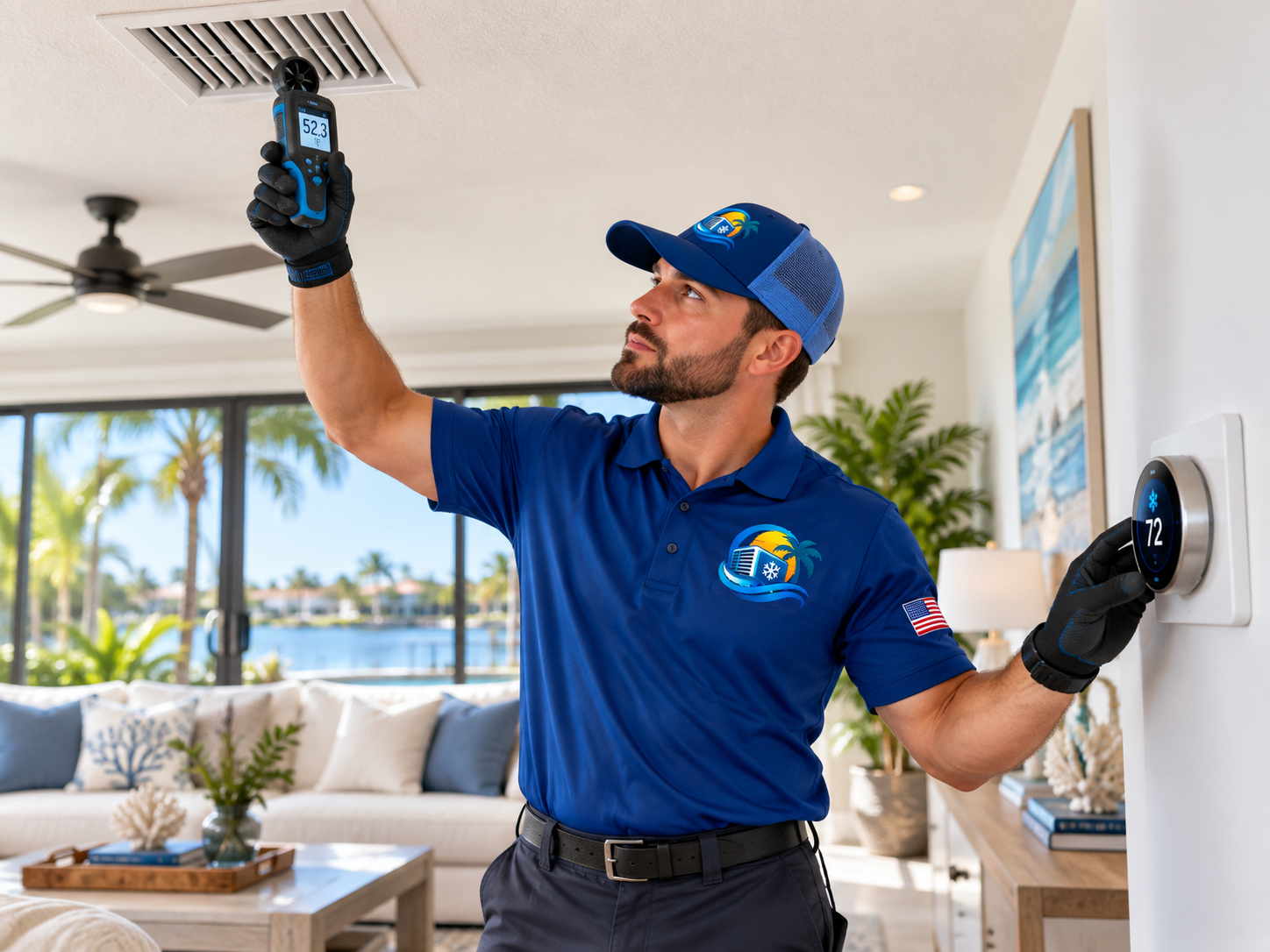
Controls first, then electrical values at the condenser, then the air side including static pressure, then refrigerant pressures with superheat and subcooling. Instruments, not assumptions. Typically 30 to 60 minutes for a thorough picture.
3. Findings and options
You hear what failed, what caused it, what the repair involves, and the price. Where more than one reasonable path exists, you get both with the tradeoffs spelled out. Nothing proceeds until you approve it.
4. The repair
Work is done to manufacturer specification — refrigerant charged by weight rather than by feel, connections properly terminated, drains correctly sloped and secured, and the underlying cause addressed rather than the symptom alone.
5. Verification
Readings are taken again after the repair and compared against expected ranges, confirming the system is operating correctly rather than merely running. Anything still outside spec should be explained before the visit ends.
What gets measured
The readings that drive conclusions
These are the values that separate one cause from another when symptoms look identical.
Capacitor microfarads
Compared against the rated value on the part. Drift below tolerance strains motors long before an outright failure.
Compressor and fan amp draws
High draw suggests mechanical strain, heat rejection problems, or electrical faults; low draw can indicate a weak compressor.
Static pressure
Reveals airflow restriction from filters, coils, blower wheels, or duct problems — the cause behind many freeze-ups.
Temperature split
The difference between return and supply air. Too small suggests low capacity; too large suggests restricted airflow.
Superheat and subcooling
Together these indicate whether refrigerant charge and metering are correct — the only reliable way to evaluate charge.
Control voltage and thermostat call
Confirms the system is being told to run at all, which rules out control faults imitating equipment failure.
Your part
How to prepare for the visit
Clear access to both units saves real time: unlock the gate to the outdoor unit, clear a path to the attic hatch or utility closet, and secure pets. If the air handler is in an attic, note whether the walkway and lighting are usable.
Have any history handy. The approximate age of the system, whether refrigerant has been added before, and what previous repairs were done all change how readings are interpreted. If you can photograph the data plate on the outdoor unit, the model and serial numbers reveal manufacture year and refrigerant type.
Finally, describe behavior rather than diagnosis. "The outdoor unit hums but the fan does not spin" is far more useful than "I think the compressor is bad," because the first is an observation and the second is a conclusion that may send diagnosis in the wrong direction.
Process questions
- What happens during the diagnostic portion of the visit?
- It is a sequence of measurements rather than a look around. The thermostat call and control voltage get verified first, because a control problem can imitate almost any equipment failure. Then electrical values at the outdoor unit: capacitor microfarads against the rated value, contactor condition, and compressor and fan amp draws. Then the air side: filter condition, blower operation, and static pressure to reveal restriction. Then refrigerant pressures with superheat and subcooling, plus temperature split across the coil. Together those readings usually identify one cause rather than several possibilities.
- Will I be told the price before work starts?
- Yes. After diagnosis you hear what was found, what the repair involves, and what it costs, before anything is installed. If more than one reasonable option exists — repairing a component versus replacing a larger assembly, or repairing versus replacing the system — you get both paths with costs and the expected outcome of each. Nothing proceeds without your approval. If a part must be ordered, you are told that along with what to expect in the meantime.
- What if the problem turns out to be several issues at once?
- That is common on systems that have gone years without service, and the honest approach is to separate them by urgency. Some conditions prevent the system from cooling at all and must be corrected now. Others are degrading performance or shortening equipment life and can be scheduled. Others are worth knowing about but do not require action yet. You get that breakdown rather than one large number, so you can decide what to address immediately and what to plan for.
- Do you verify the repair worked before leaving?
- Yes, and this step matters more than it sounds. A system that turns on is not necessarily a system operating correctly. After the repair, readings get taken again — amp draws, temperature split, static pressure, and refrigerant values where applicable — and compared against expected ranges. That confirms the repair actually resolved the fault instead of masking it, and it occasionally reveals a second condition that only becomes visible once the first is fixed.
- What do you need from me to make the visit efficient?
- Three things help most. A clear description of behavior — whether the blower runs, whether the outdoor unit runs, whether air is cool at all, any ice, water, or breaker trips, and how long it has been happening. Access to both units: an unlocked gate, a clear path to the attic hatch or closet, and pets secured. And any history you know: the approximate age of the system, previous repairs, and whether refrigerant has been added before. That last detail in particular changes how a low-charge diagnosis is interpreted.
Talk through your AC problem now
Describe what your system is doing — not cooling, leaking, freezing, short cycling, or completely off — and get straightforward next steps.
Air Conditioner Repair Palm Bay FL1501 Robert J Conlan Blvd NE, Suite #459
Palm Bay, FL 32905