
Educational diagram
Why Your AC Is Not Cooling
Six causes account for the large majority of no-cooling calls in Palm Bay. Each leaves different evidence, and each has a very different repair cost.
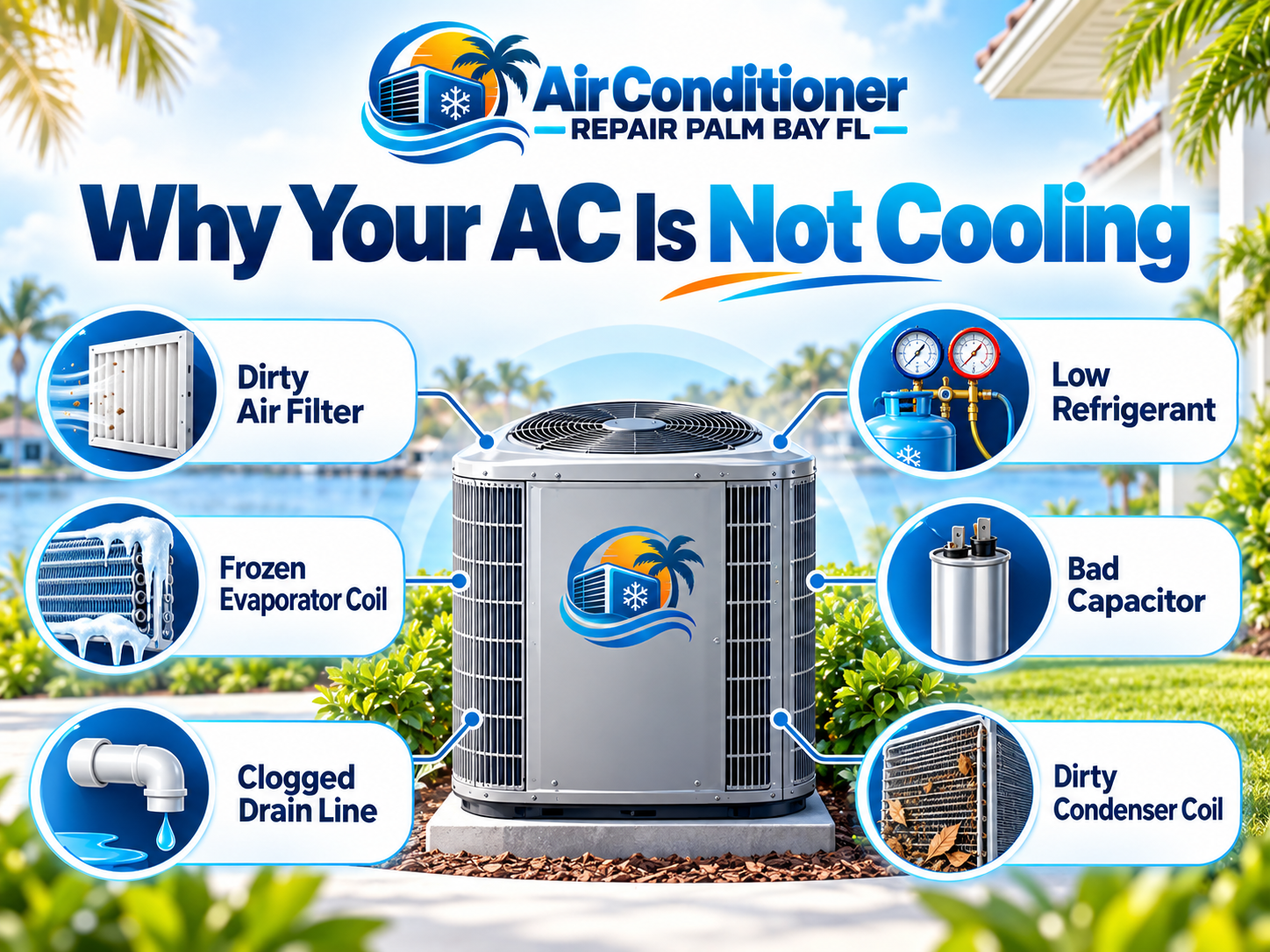
Cause by cause
What each one looks like
1. Dirty air filter
Restricted airflow means less heat reaches the coil, so cooling weakens and the coil can drop below freezing. Symptoms: weak airflow at registers, longer run times, sometimes ice. The cheapest fix on this list and the first thing to check.
2. Low refrigerant from a leak
A sealed system does not consume refrigerant, so low charge means a leak. Symptoms build gradually: declining capacity over a season, longer cycles, poor humidity control, eventually ice on the suction line. Repair means finding and fixing the leak, not just recharging.
3. Frozen evaporator coil
Ice blocks the coil so almost no air passes through, and cooling stops entirely. It is always a symptom of something else — restricted airflow or low charge. Thawing restores temporary operation; identifying the cause prevents recurrence.
4. Failed run capacitor
The capacitor gives the fan and compressor motors the phase shift they need to start. When it weakens, the outdoor unit hums without starting, or the fan runs while the compressor does not. Common in Florida heat and one of the least expensive repairs.
5. Clogged condensate drain line
Biological growth blocks the drain, water backs into the pan, and a float switch shuts the system off to prevent damage. The house stops cooling even though the equipment is mechanically fine. Without a float switch, you get water damage instead.
6. Dirty condenser coil
The outdoor coil cannot reject heat when fins are packed with grass clippings, leaf debris, or salt film. Cooling falls off sharply on the hottest afternoons, pressures rise, and in severe cases the compressor trips on overload.
Narrowing it down
Match your symptom to a cause
If the indoor blower runs but the outdoor unit does not, focus on electrical: capacitor, contactor, control voltage, or a tripped breaker. If both units run and air from the registers is barely cool, focus on capacity: dirty coils, refrigerant charge, or a weak compressor. If airflow at the registers is clearly weak, focus on the air side: filter, blower, ice on the coil, or duct problems.
If nothing runs at all and the thermostat display is normal, check for a tripped float switch — a system shut down by its safety device looks completely dead even though the equipment is fine. If nothing runs and the thermostat is blank, control power is the place to start.
This is not a substitute for measurement, but it does tell you which family of problems you are dealing with, and it makes the conversation with a technician far more productive.
Cost perspective
These causes are not equally expensive
A filter costs a few dollars. A drain clearing or a capacitor replacement is a modest service call. A condenser coil cleaning is inexpensive relative to the capacity it restores. A refrigerant leak repair is a mid-range job that depends heavily on leak location and refrigerant type. A coil replacement is expensive, and a compressor replacement is the point where replacement of the system usually deserves a serious comparison.
That spread is precisely why diagnosis matters. Replacing an expensive component when an inexpensive one failed is the most common way homeowners overspend on air conditioning, and it happens when parts are replaced on a guess rather than on measurements.
No-cooling questions
- Which of these causes is most common?
- Restricted airflow from a dirty filter is the single most common, and it is the one homeowners can fix themselves in two minutes. Close behind are failed run capacitors, which are extremely common in Florida because sustained heat degrades them, and clogged condensate drain lines, which are near-universal in a humid climate. Refrigerant leaks and dirty condenser coils are also frequent but produce more gradual symptoms. Compressor failure is the least common of the serious causes, though it gets blamed most often — which is why measurement matters before anyone concludes the compressor is finished.
- Can more than one of these be happening at once?
- Yes, and on systems that have gone several years without service it is the norm rather than the exception. A restricted filter reduces airflow, which lowers coil temperature and can lead to freezing; the freeze-thaw cycle overwhelms the drain pan and contributes to drain problems; meanwhile the outdoor coil has been collecting debris and the capacitor has drifted below its rated value. Fixing only the most obvious item leaves the system underperforming. That is why a thorough diagnosis takes readings across the whole system rather than stopping at the first fault it finds.
- How do I tell a refrigerant problem from an airflow problem?
- Both can freeze a coil and both reduce cooling, so the difference shows up in measurements rather than symptoms. With restricted airflow, the temperature drop across the coil is unusually large while total air volume is low, and static pressure reads high. With low refrigerant charge, superheat runs high and subcooling low, suction pressure is low, and the temperature drop across the coil is small even though airflow is normal. Homeowners can rule airflow in or out partly by checking the filter and feeling register airflow; separating the rest requires gauges and instruments.
- Is a dirty condenser coil really enough to stop cooling?
- It is enough to cause serious capacity loss, especially in Palm Bay. The outdoor coil's job is rejecting heat into outdoor air that may already be in the nineties, so it has little margin. When fins are packed with grass clippings, leaf debris, or salt film, head pressure rises, efficiency falls, and cooling capacity drops sharply on exactly the hottest afternoons. Severe cases cause the compressor to trip on internal overload, which looks like a failed compressor. Cleaning the coil properly often restores performance that had been quietly disappearing for a couple of seasons.
- What should I do before calling about no cooling?
- Four steps, in order. Confirm the thermostat is on Cool, the fan on Auto, the setpoint below room temperature, and replace batteries if it has them. Check the filter and replace it if it is loaded. Check the breaker panel and the outdoor disconnect for a tripped breaker — reset once, but not repeatedly. Look for ice on the indoor coil or refrigerant lines, and if you find it, switch the system Off with the fan On to thaw. If cooling does not return after those steps, the remaining causes need instruments to identify.
Talk through your AC problem now
Describe what your system is doing — not cooling, leaking, freezing, short cycling, or completely off — and get straightforward next steps.
Air Conditioner Repair Palm Bay FL1501 Robert J Conlan Blvd NE, Suite #459
Palm Bay, FL 32905