
Palm Bay, FL · 321-804-8235
AC Not Cooling Repair in Palm Bay, FL
When an air conditioner runs but does not cool, the cause is almost always one of four things: not enough airflow, not enough refrigerant, a coil that cannot transfer heat, or an electrical part that stopped the compressor while the blower kept running.
What this service covers
"Running but not cooling" is the single most common AC complaint in Palm Bay, and it is also the most misdiagnosed. The blower can happily circulate air all afternoon while the part that actually removes heat sits idle or works against a restriction.
The useful first question is whether the outdoor unit's compressor and fan are running at all. If they are not, the problem is usually electrical. If they are, attention shifts to airflow across the indoor coil, coil cleanliness, and refrigerant charge.
Symptoms
Signs you need this repair
- Air from the registers is barely cool or feels like room temperature
- The thermostat setpoint is never reached, even after hours
- Outdoor unit is silent while the indoor fan runs
- The temperature difference between return and supply air is small
- Humidity indoors is climbing along with temperature
- Cooling was fine last week and degraded suddenly
Causes
What usually causes the problem
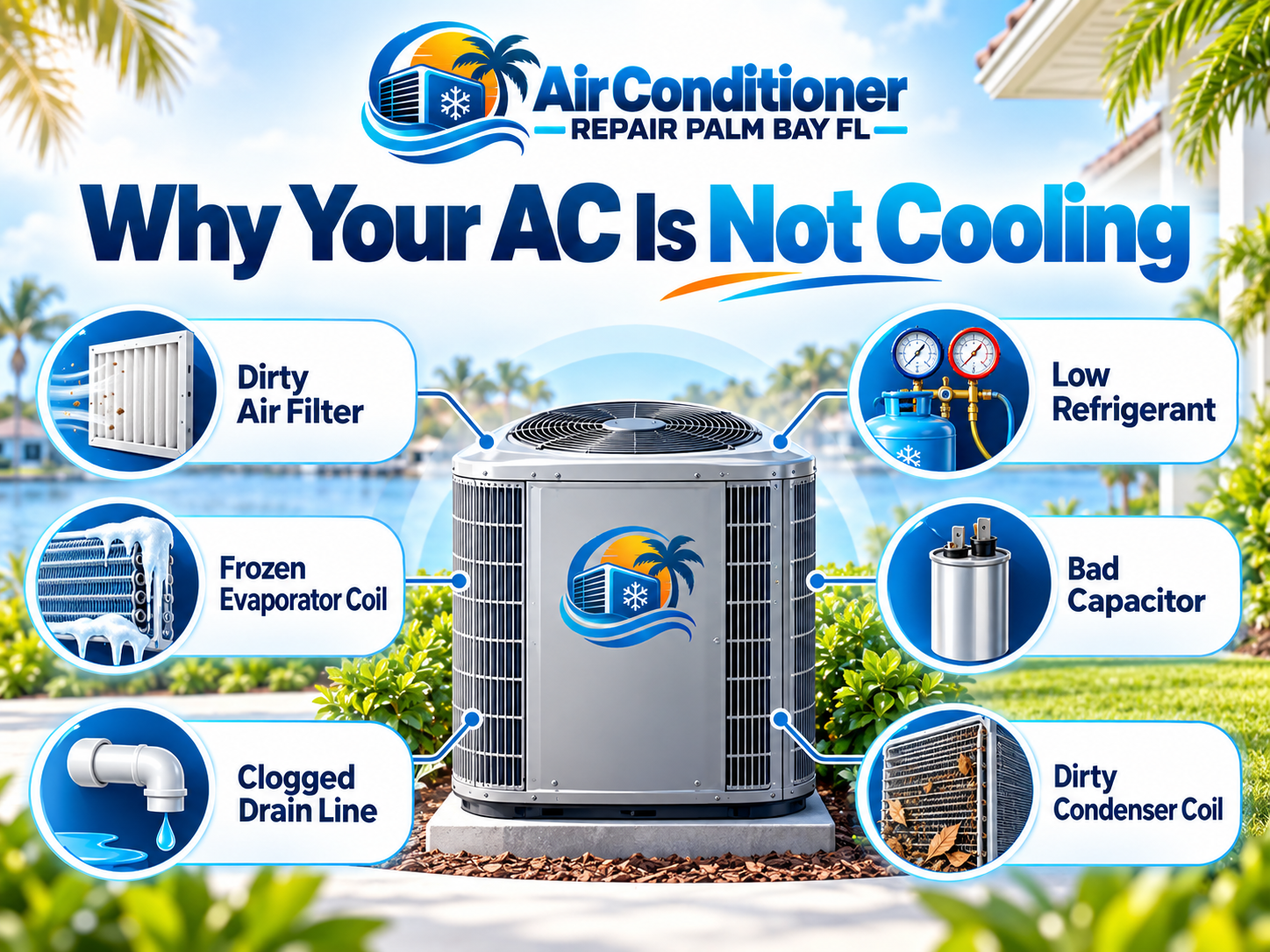
Dirty or restrictive air filter
The most common and most fixable cause. A heavily loaded filter starves the coil of air, cutting capacity and eventually causing ice.
Failed run capacitor
A weak capacitor can stop the compressor or condenser fan while the indoor blower keeps running, producing warm air from the vents.
Low refrigerant from a leak
Reduced charge lowers heat absorption. It also causes low suction pressure, which can freeze the coil and make cooling worse over time.
Dirty condenser coil
If the outdoor coil cannot reject heat, the whole cycle loses capacity. Grass clippings and salt residue are frequent culprits here.
Dirty evaporator coil or blower wheel
Years of filtered-but-not-perfect air leave a film that insulates the coil and reduces airflow simultaneously.
Thermostat or control fault
A thermostat calling for fan without cooling, or a failed contactor, produces exactly this symptom with no mechanical damage at all.
Diagnosis
How the problem is diagnosed
Measurement comes before parts. These are the checks that separate one cause from another.
- Whether the compressor and condenser fan are actually running
- Filter loading and return air restriction
- Return-to-supply temperature split
- Capacitor microfarad values and contactor operation
- Condenser and evaporator coil cleanliness
- Refrigerant pressures with superheat and subcooling
- Blower wheel condition and fan speed setting
- Thermostat wiring and control voltage
Repair options
What the repair involves
Airflow restoration
Filter correction, coil cleaning, and blower cleaning frequently recover most or all of the lost cooling, especially on systems several seasons past their last service.
Electrical repair
Capacitor and contactor replacement is a common, same-visit fix when the compressor or outdoor fan is not running.
Leak repair and recharge
Simply adding refrigerant without finding the leak is a temporary measure. Locating and correcting the leak is the actual repair.
Coil replacement
Where the evaporator coil is leaking or badly corroded, replacement restores heat transfer and holds a proper charge.
Urgency
How quickly this should be handled
Indoor temperature climbing above safe levels during extreme heat
Visible ice on lines or coil, which should prompt shutting the system off
Repeated breaker trips accompanying the loss of cooling
A compressor that hums loudly for several seconds and then stops
Palm Bay conditions
Why this happens here
Palm Bay homes deal with high outdoor dew points, so a system with reduced capacity fails a second test: it cannot dehumidify. Homeowners often notice the sticky feeling before they notice the thermostat reading, and both point to the same underlying restriction or charge problem.
Lawn maintenance is another local pattern worth mentioning. Grass clippings blown into the condenser coil form a mat that looks harmless and reduces cooling substantially, especially at the highest afternoon temperatures.
Cost
What affects the price of this repair
No two systems are identical. These factors move the number up or down, and each is explained before work begins.
Cleaning versus part replacement
Coil and blower cleaning is labor-driven; capacitor and contactor work is inexpensive; coil or compressor work is at the top of the range.
Whether a refrigerant leak exists
Leak search, repair, evacuation, and weighed charge add materially to a repair compared with a purely electrical fault.
System age and refrigerant type
R-22 systems raise the cost of any charge-related repair and often shift the conversation toward replacement.
Access and system location
Attic coils and cramped closets take longer to clean or service than garage-mounted equipment.
Frequently asked questions
- Why is my AC running constantly but not cooling the house?
- Continuous operation with poor cooling means the system is removing less heat than the home is gaining. The likeliest causes are restricted airflow from a loaded filter, dirty coil, or dirty blower wheel; refrigerant charge that has dropped because of a leak; a condenser coil that cannot reject heat; or a compressor that is not running while the blower is. Duct leaks in a hot attic produce the same symptom by delivering cooled air where nobody lives. Checking the filter and looking at whether the outdoor unit is actually running are the two things a homeowner can usefully do before calling; the rest requires measurements.
- Can I just add refrigerant to fix an AC that is not cooling?
- Adding refrigerant treats a symptom. A sealed refrigerant circuit does not consume refrigerant, so low charge always means a leak somewhere: a coil, a fitting, a service valve, or the line set. Charging without addressing the leak means the same complaint returns, usually sooner each time, while the compressor operates under conditions it was not designed for. Proper practice is to confirm charge is actually low through pressure, superheat, and subcooling readings, locate the leak, repair or replace the leaking component, evacuate the system, and weigh in the correct charge. That is what makes the fix durable.
- How big should the temperature difference be at my vents?
- For most residential systems in cooling, the difference between return air and supply air typically falls in the high teens to low twenties in degrees Fahrenheit, with humidity conditions influencing the number. A small split — say under about 12 degrees — often points to low airflow, low refrigerant charge, or a compressor that is not pumping properly. An unusually large split can indicate airflow that is too low, which sounds counterintuitive but happens when a restriction slows air across a cold coil. Because interpretation depends on indoor humidity and outdoor conditions, the reading is a diagnostic clue rather than a verdict on its own.
- Why does my AC cool at night but not in the afternoon?
- That pattern usually means the system has lost capacity and can only keep up when the load is low. As afternoon temperatures and solar gain peak, the deficit becomes visible. Common causes include a dirty condenser coil that cannot reject heat at high ambient temperatures, refrigerant charge that is somewhat low, restricted airflow, and a marginal capacitor that struggles when components are hottest. Duct losses in a superheated attic contribute as well. Because everything still works at night, this often gets postponed — but a system running at its limit every afternoon is also the one most likely to fail during the hottest week.
Areas we serve in Palm Bay
Talk through your AC problem now
Describe what your system is doing — not cooling, leaking, freezing, short cycling, or completely off — and get straightforward next steps.
Air Conditioner Repair Palm Bay FL1501 Robert J Conlan Blvd NE, Suite #459
Palm Bay, FL 32905