
Educational diagram
How a Central Air Conditioning System Works
Understanding the parts and how they interact makes every repair conversation clearer — and it explains why a problem outdoors shows up as a symptom indoors.
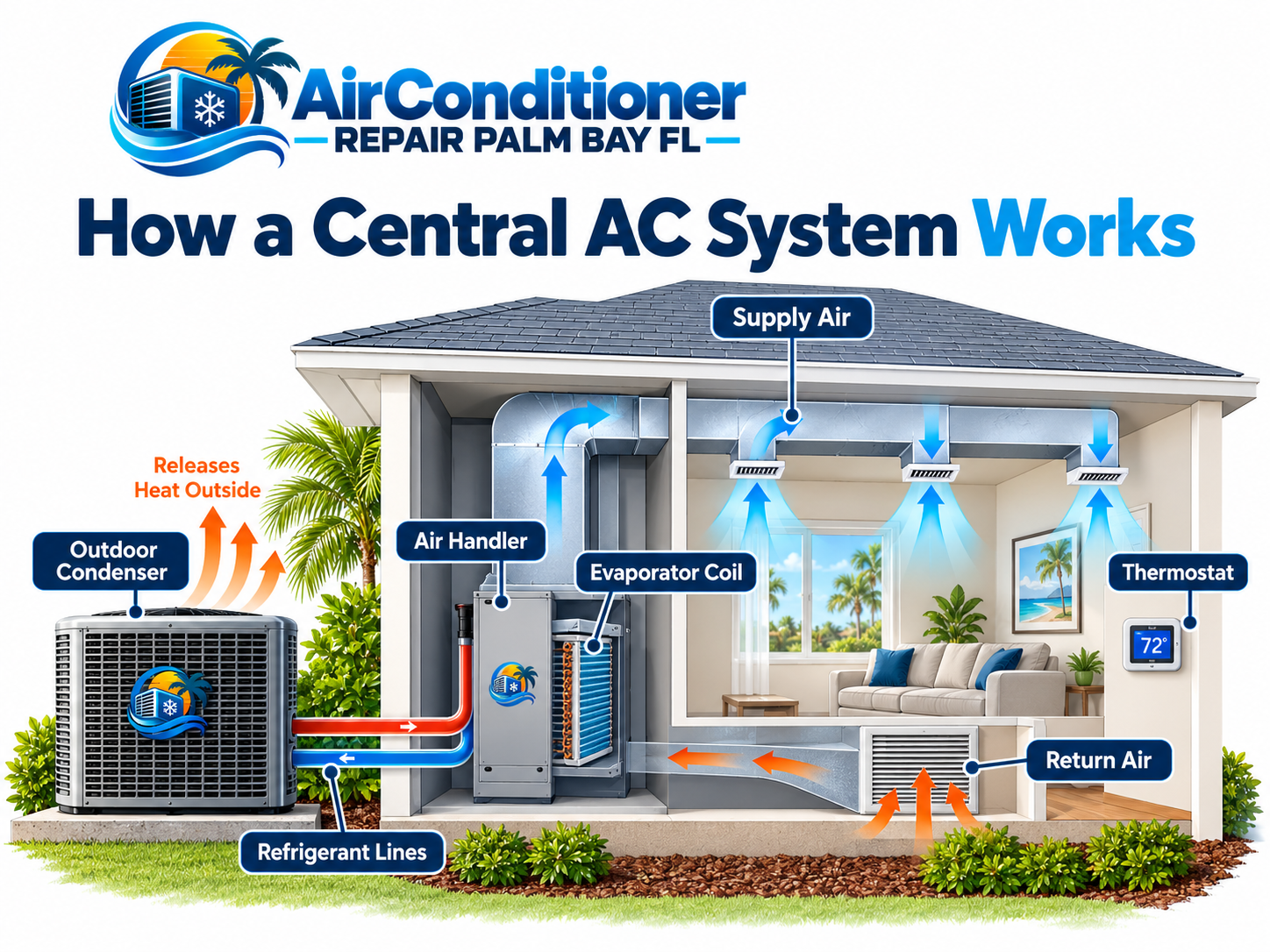
The core idea
An air conditioner moves heat, it does not make cold
Every cooling cycle does the same thing: it collects heat from inside your house and dumps it outside. Refrigerant is the carrier. Inside, it evaporates in the cold evaporator coil, absorbing heat from the air blowing across it. Outside, the compressor raises its pressure so it is hotter than the outdoor air, and the condenser coil releases that heat before the refrigerant returns to liquid and repeats the loop.
This is why outdoor conditions matter so much in Palm Bay. On a 95-degree afternoon, the outdoor coil has to reject heat into air that is already hot, which requires clean fins and full airflow. Block that coil with leaf debris, salt film, or overgrown shrubs, and cooling drops indoors even though nothing inside the house has changed.
It also explains why the two units cannot be evaluated separately. A dirty indoor coil raises pressures in the outdoor unit; a failing outdoor fan makes the indoor coil behave abnormally. Good diagnosis reads both ends of the system before deciding what failed.
Components
What each part does
Outdoor condenser unit
The cabinet outside. It houses the compressor, the condenser coil, and a fan that pulls air across that coil to release heat collected from indoors. It needs clear space and clean fins to do its job.
Compressor
The pump that drives the refrigerant cycle by raising refrigerant pressure and temperature. It is the most expensive single component and the one most affected by weak capacitors, poor airflow, and low charge.
Indoor air handler
Contains the blower, evaporator coil, filter, and drain pan. It moves house air across the cold coil, which is where both cooling and dehumidification actually happen.
Evaporator coil
The cold indoor coil. Refrigerant evaporates inside it, absorbing heat from passing air, while moisture condenses on its surface and drains away.
Refrigerant lines
Two insulated copper lines connecting indoor and outdoor units — a larger suction line and a smaller liquid line. Damaged insulation or a leak in either affects performance.
Condensate drain
Carries the water condensed on the evaporator coil out of the home. In Florida this handles a large volume nearly year-round, which is why clogs are so common.
Supply and return ducts
Returns bring room air back to the air handler; supplies deliver conditioned air to rooms. Leaks, crushed runs, and missing insulation in hot attics cost real capacity.
Thermostat
The control that senses room temperature and starts or stops the cycle. Placement, wiring, and configuration all affect whether the system behaves correctly.
Cycle
What happens when you set the thermostat lower
The thermostat closes a circuit, which energizes the indoor blower and signals the outdoor unit to start. The compressor begins circulating refrigerant, the condenser fan pulls outdoor air across the outdoor coil, and within a minute or two the indoor coil becomes cold enough to absorb heat from the air passing over it.
Air from your rooms enters the return, passes through the filter, crosses the cold evaporator coil where it gives up heat and moisture, then travels through the supply ducts back into the house. Condensed water drips into the pan and leaves through the drain line. This continues until room temperature reaches the setpoint, at which point the thermostat opens the circuit and everything stops.
Because most residential systems run at one fixed capacity, setting the thermostat to 65 does not cool faster than setting it to 74 — it simply runs longer without stopping. Understanding that saves both money and frustration on a hot afternoon.
Why it matters
How this connects to repairs
Almost every repair on this site maps to one part of the diagram above.
A hum without starting is usually electrical at the condenser. Ice on the indoor coil is airflow or refrigerant charge. Water on the floor is the condensate path. Weak air at distant registers is duct distribution. Knowing which part of the cycle a symptom belongs to makes it far easier to understand what a technician found and why the recommended repair addresses it.
It also helps you spot explanations that do not add up. If someone says a system needs replacement because it is not cooling, but the outdoor coil is packed with debris and the filter has not been changed in a year, those conditions need to be corrected and the system re-measured before that conclusion holds.
How it works — questions
- Does an air conditioner create cold air?
- No — it moves heat. Warm indoor air is pulled through the return, passes across the cold evaporator coil, and gives up heat to the refrigerant inside that coil. The refrigerant carries that heat outdoors, where the compressor raises its pressure and temperature and the condenser coil releases it to the outside air. The air leaving your registers feels cold because heat was removed from it, not because cold was added. That distinction matters practically: if the outdoor unit cannot reject heat — because the coil is dirty, blocked, or the fan is failing — cooling suffers indoors even though nothing looks wrong inside.
- What is the difference between the condenser and the air handler?
- The condenser is the outdoor cabinet. It contains the compressor, the condenser coil, and a fan, and its job is releasing the heat collected from inside your home. The air handler is the indoor unit, usually in a garage, closet, or attic. It contains the blower, the evaporator coil, the filter, and the condensate drain pan, and its job is moving house air across the cold coil so heat and moisture are removed. The two are connected by insulated refrigerant lines. Because they work as a matched pair, a problem in one shows up as a symptom that seems to come from the other.
- Why does an air conditioner remove humidity?
- Because the evaporator coil runs below the dew point of the air passing over it, so moisture condenses on the coil surface the same way water beads on a cold glass. That water collects in the drain pan and leaves through the condensate line. This is why a properly working system makes a home feel comfortable at a higher thermostat setting than a struggling one — dry air at 76 degrees feels better than humid air at 73. It also explains why short cycling hurts comfort: a system that satisfies the thermostat quickly never runs long enough to remove much moisture.
- What does the thermostat actually control?
- It is a switch with a temperature sensor, not a throttle. When room temperature rises above the setpoint, the thermostat closes circuits that energize the blower and the outdoor unit. When temperature reaches the setpoint, it opens those circuits and the system stops. Most residential systems run at a fixed capacity, which means setting the thermostat far lower does not make the house cool faster — it only makes the system run longer. Variable-capacity systems modulate output, but even there the thermostat is requesting a condition, not commanding a speed.
- Why do supply and return air both matter?
- They are two halves of one loop. Supply ducts deliver conditioned air into rooms; returns pull room air back to the air handler to be cooled again. If return airflow is restricted — by a loaded filter, undersized return, or closed doors with no return path — the blower cannot move its design airflow, capacity drops, dehumidification suffers, and the coil can freeze. Many comfort complaints that look like inadequate equipment are really return-side restrictions, which is why static pressure measurement is part of a thorough diagnosis.
Talk through your AC problem now
Describe what your system is doing — not cooling, leaking, freezing, short cycling, or completely off — and get straightforward next steps.
Air Conditioner Repair Palm Bay FL1501 Robert J Conlan Blvd NE, Suite #459
Palm Bay, FL 32905